Text Daniel Giebel ––– Photography
1.
WIRE PROCESSING:
A wire feeder unit transfers the wires that have been preassembled in the Wire Terminal to the Wire Handling System.
2.
WIRE DISTRIBUTION:
The Wire Handling System uses compressed air to distribute the wires that have been fully prepared on a project-specific basis to as many as four workstations.
3.
WIRE REMOVAL:
The removal station receives each preassembled wire and then makes it available for the wiring process.
Mr. Kramer, what is the idea behind the Wire Handling System?
Many workshops are already using the Rittal Wire Terminal WT to automate wire processing. In most cases, however, these wires then have to be distributed manually – a time-consuming process with potential for errors. That’s where the new Wire Handling System (WHS) comes in. It uses compressed air to transport the preassembled wires to a number of remote workstations automatically. This is the next logical step in the end-to-end automation of panel building.
How does wire distribution work in practice?
Depending on how the process is planned, wires are produced either on demand or in a predetermined sequence. The special feature of the WHS is that wires can be sent directly to as many as four workstations, over a distance of up to 80 metres. When each wire reaches its destination, it is detected by sensor technology that slows it down and makes it available for further processing – precisely, reliably and exactly when it is needed.
Where does the information telling the system which wire belongs where come from?
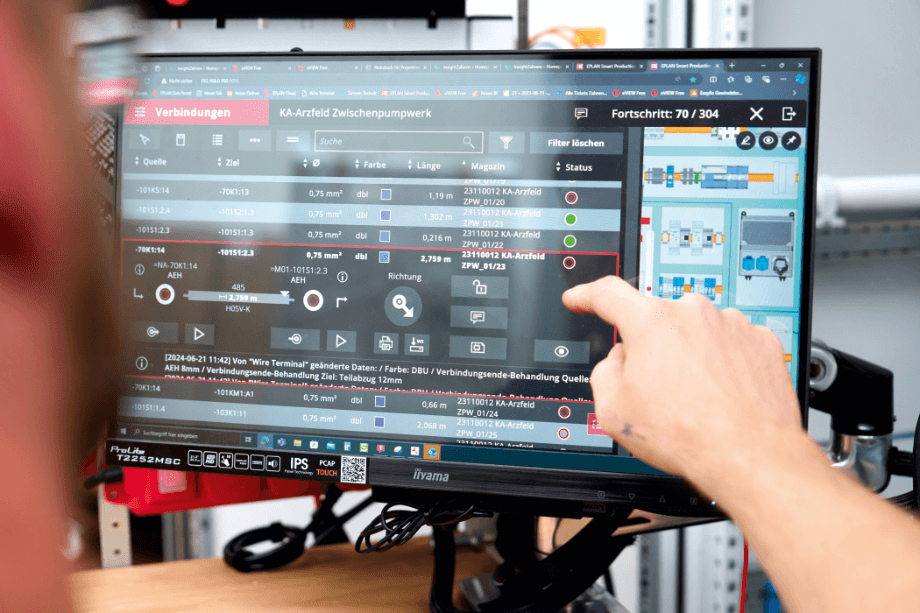
That’s based on digital planning with Eplan. Many of our customers are already using Eplan Pro Panel. The data defined in this software – i.e. a wire’s cross-section, colour, length and target component – is transferred to the Wire Terminal. The result is an intelligent wire list that the Eplan Smart Wiring assistance system utilises to act as a guide for the wiring process. This means the WHS always knows which wire is needed where at a given time.
Is the process as highly reliable as it sounds?
Absolutely! The big advantage is the end-to-end data chain. Each wire is defined digitally, produced digitally and can be traced digitally. This all but eliminates manual errors, and because the system is directly linked to production, several projects can run in parallel without any data conflicts or bottlenecks. The way the Wire Terminal is programmed means it can prioritise jobs – if a workstation needs a wire right away, for example.
There’s also been a real improvement in terms of wire processing time. Can you tell us about that?
Yes, that’s an important point. With the latest software and technology, our Wire Terminal is now achieving a processing time of just 8 seconds or so per wire. It used to be around 13.8 seconds. Almost doubling the speed in this way is particularly beneficial for series production operations and bigger projects.
How automated has panel building already become in reality – and how much is still just a vision?
I’d say that with solutions such as the Wire Terminal, the WHS and the Eplan platform, the automation process is in full swing. Many of our customers are currently undertaking this very transformation, moving away from manual processes towards digitally networked workflows. The WHS is a key element when it comes to plugging the gap between automated production and an efficient shopfloor.
What does that mean for customers in concrete terms?
Less walking back and forth for staff, less time spent finding things, and fewer errors. Above all, though, a transparent and scalable end-to-end process. The WHS gets the wires exactly where they are needed, without any diversions, and it fits flexibly into the actual production situation on site – from custom wiring through to series production.