Text Ulrich Sendler ––– Photography
Reshoring is the new buzzword. “The US government is going all out to bring manufacturing back to America. That calls for engineers, and it is these engineers who will shape the future,” says Michael Jeschke, Vice President North & South America at Eplan. “However, the shortage of skilled electrical engineers is even worse in the USA than elsewhere,” he reveals. To boost productivity, industrial companies need to reinvent themselves and undergo a technological transformation. In other words, they must digitalise and automate their value creation processes. That is only possible with skilled workers, though. What’s more, the working methods normally used by skilled staff in the USA still offer plenty of scope for automation. As Jeschke knows, for example, most switchgear is still designed with the help of 2D CAD drawings rather than using the data-driven approach that is already standard at many industrial companies across the globe..
BIG PRESSURE
There is huge demand for talented young recruits in the USA. By 2030, the Boston Consulting Group (BCG) estimates that companies will be on the lookout for around 400,000 engineers – every year! The most urgent demand will be for electrical engineers (BCG study, December 2023). Whereas the US labour market is set to grow by 3 percent between now and 2034, the US Bureau of Labor Statistics (BLS) is expecting to see more than double this increase for electrical engineers, namely 7 percent (BLS, 12 November 2025). State investments in recent years due to the 2021 Infrastructure Investment and Jobs Act (IIJA) are one reason for this. Besides the transport network, sectors such as water management have also seen a resulting surge in demand.
TOP UNIVERSITY – POTENTIAL RECOGNISED
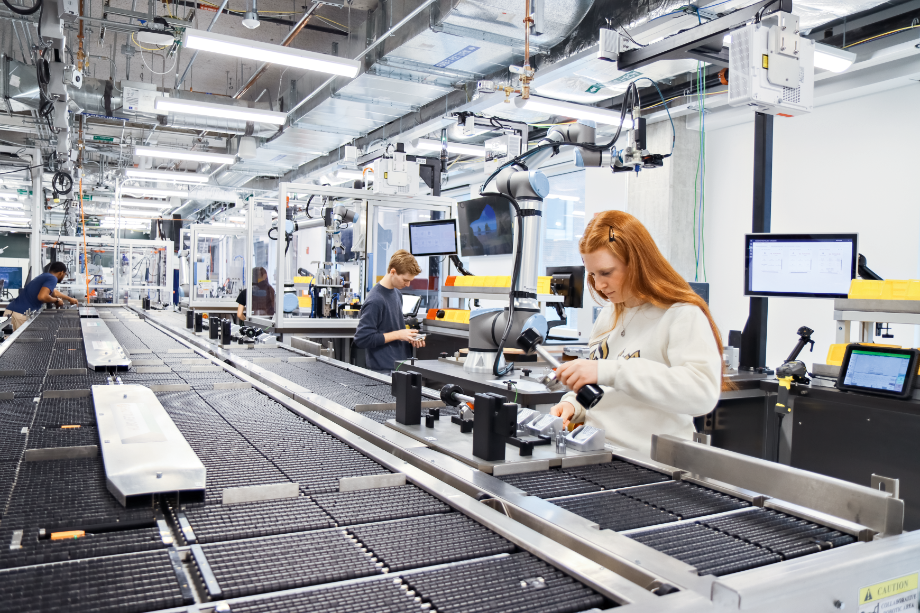
Purdue Polytechnic has acted accordingly. Ever since it was founded, this institute has set its sights on providing students with practical training so they can start helping the industry to move forward as soon as they graduate. The goal of the partnership with Eplan and Rittal is to ensure these future electrical engineers can harness the power of data-driven automation for this purpose. The initial collaboration period is five years.
Regarded as one of the USA’s top universities when it comes to educating and training the technical elite, Purdue was founded in 1869 in Lafayette, in the state of Indiana. The research-oriented Interdisciplinary Science Rankings 2026 for public institutions, which was compiled by the British magazine “Times Higher Education”, ranks Purdue tenth in the world and third in the USA.
Jeff Kilburn, Vice President Business Solutions at Eplan in the USA, is himself a Purdue graduate. Back in the day, he experienced the paradigm shift from drawing to computer-aided design (CAD) first-hand. Now, he is proud to be playing a part in the next big step – towards data-driven electrical engineering.
AT THE CUTTING EDGE
“That’s what drives the people at Purdue,” says Kilburn. “They always want to be at the cutting edge of technological development. They know that’s exactly what Eplan offers, and that’s why they’re keen to join forces,” he adds. After all, Eplan practises logic-based rather than drawing-based engineering. For example, data from the circuit diagram can be used to generate parts lists and serves as a basis for the 3D layout in Eplan Pro Panel. This creates a complete digital twin of the relevant enclosure. Machines from Rittal Automation Systems can automate the process of adding the necessary cut-outs and drilled holes, and wire processing can also be automated. This same end-to-end process is now taught at Purdue.
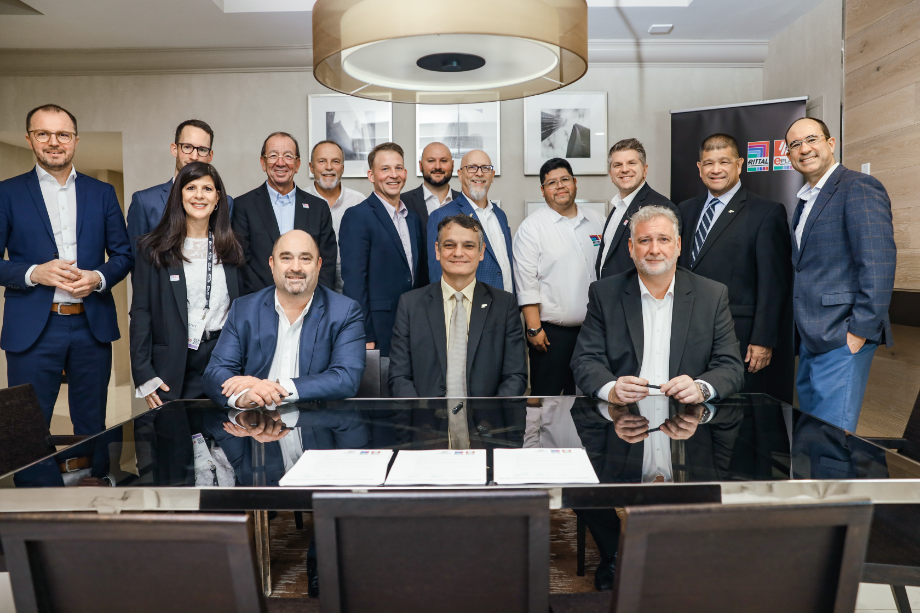
The official signing of the partnership agreement between Purdue, Eplan and Rittal took place at the Rockwell Automation Fair on 20 November 2025. Rockwell Automation, the US market leader when it comes to automation, welcomes some 11,000 customers and its comprehensive dealer network to this annual event. Eplan and Rittal had their own booth at the fair, which was also attended by around 100 students from Purdue. This reflects the close partnership that Purdue has also maintained with Rockwell Automation for decades. Just like Rockwell, Eplan and Rittal now also each have a representative on the Dean’s Advisory Council.
PURDUE UNIVERSITY
Purdue University is more than just the globally renowned “Cradle of Astronauts” (nearly 20 NASA astronauts studied there, starting with Neil Armstrong). The Purdue Polytechnic Institute is also regarded as a trailblazer for education and training in the STEM (science, technology, engineering and mathematics) disciplines. Mention STEM – especially in Ohio, Michigan or Indiana – and the university based in West Lafayette immediately springs to mind.
THE PARTNERSHIP WITH RITTAL AND EPLAN
• Purdue Polytechnic is becoming a strategic research partner in the Rittal and Eplan Partner Network
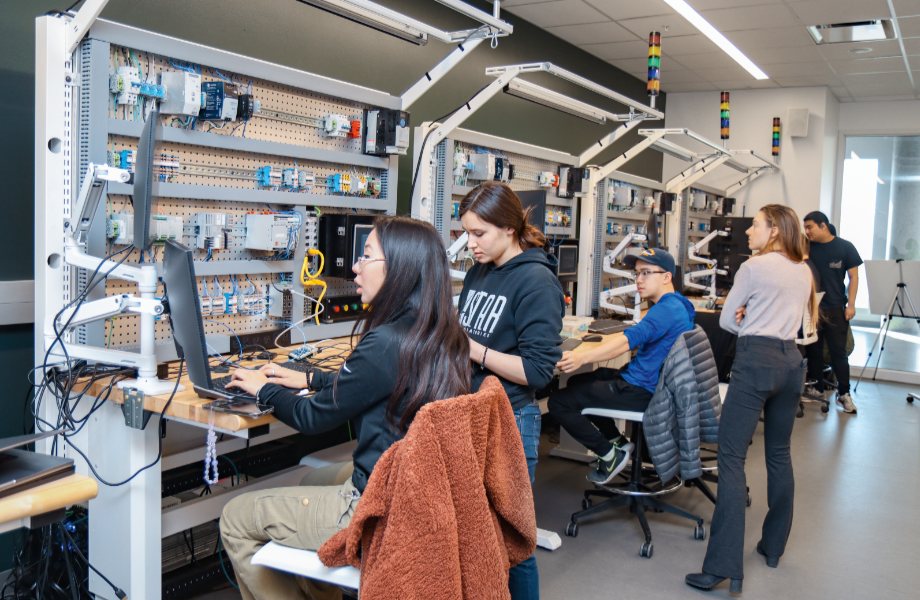
• An Eplan Electrical Engineering Technology Projects Lab is opening in Purdue Polytechnic’s Dudley Hall
• A Rittal Automation Systems Lab is being set up
• Purdue Polytechnic is getting a significant number of Eplan software licences, initially for Eplan Electric P8 and Eplan Pro Panel
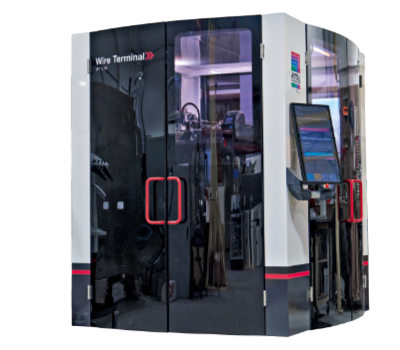
• A Wire Terminal WT from Rittal will help students learn all about fully automated wire processing
• Wire Handling System WHS for automatic wire transport to working positions in a different room
THE GOAL – CHANGE AGENTS
Purdue is expecting a great deal from the partnership. During their training, it wants students to do more than just get to grips with the technologies that make smart manufacturing possible. “They should learn by doing – and study for what they’ll be doing in the future,” says the Dean of Purdue Polytechnic, Dr Daniel Castro. “We align our approach closely with Germany’s engineering programmes at institutions such as universities of applied sciences, and not just by organising collaborations and internships with industrial companies. The future skilled workers who are being trained in this way are exactly the ones who are urgently needed. By incorporating world-class solutions from Rittal and Eplan into our curriculum, we are moving well beyond teaching theory. As a result, students acquire the skills and knowledge they need to lead the way,” he emphasises.
Lecturer Grant P. Richards has the following to add: “The aim of our programmes is to train change agents who will help the industry successfully leverage the latest technologies from day one after they graduate. At trade shows and industry events in recent years, we have seen that the ability of Eplan to combine data from different systems into one standardised model that can then be processed on an automated basis using machines from Rittal Automation Systems is a prime example of leveraging technology in this way.”
The number of electrical engineering students at Purdue Polytechnic is set to grow very rapidly, from the current level of a few hundred to more than one thousand. In this context, Purdue is also looking to make use of its involvement with the Ivy Tech Community College of Indiana, a public institution spread across 40 locations that each year gives over 100,000 students access to technology expertise. Purdue is keen to pass on knowledge that will enable these students to make a difference from their very first day in the industry – true to the polytechnic’s “Industry Ready, Day One” motto.