Text Interview: Daniel Giebel ––– Photography
Mr. Cankurtaran, why is the global market for data centres so dynamic?
Demand for computing power is rocketing. AI applications are sending it soaring. Instead of the 11 kW needed by standard applications, AI racks at present require up to 140 kW and this will soon be 300 to 600 kW. Up to 1 MW per rack is even conceivable. Power requirements of this magnitude expose the weaknesses of AC technology, with every conversion step from AC to DC resulting in losses. What’s more, the low voltage on the AC side leads to high currents and therefore to a big additional demand for copper cables, power packs and other components. All this takes up space and is both inefficient and expensive.
Do operators have specific approaches for converting their data centres to DC?
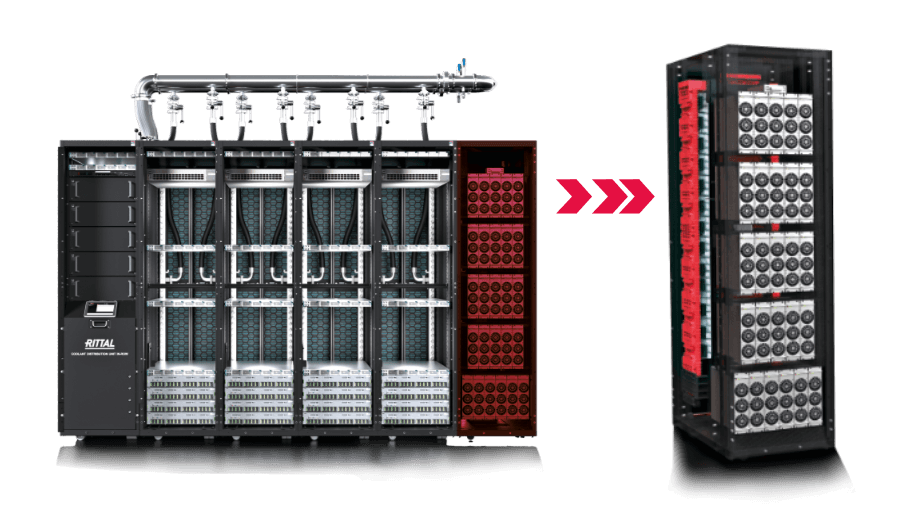
Operators are increasingly looking to transfer their power electronics to what we call “sidecars”. These sidecars supply a direct current of ±400 VDC, for example, directly to the server racks. This higher voltage reduces the currents, meaning much less copper is used. Since they eliminate a large number of conversion components, the sidecars also save space, cut costs and improve both efficiency and reliability.
Is the switch already taking place?
It is indeed. NTT and other telecom data centres are operating at 400 VDC, for example. Important momentum is coming from the Open Compute Project (OCP). Its “Diablo 400” project – supported by Microsoft, Meta, Google and Rittal – has established a globally standardised DC infrastructure with a sidecar. A dedicated project group has been created within the OCP to focus on the DC infrastructure throughout the entire data centre. Standardisation of this kind paves the way for more widespread application.
Are all the necessary components available?
All the relevant elements are already available on the market. The exception is ±400 VDC native servers, but solutions are soon expected for these as well.
How is Rittal helping data centre operators switch from AC to DC?
Rittal is already known to most hyperscalers and large colocators as a supplier of IT infrastructure. At the same time, there is growing recognition of the benefits that come with using direct current in data centres, which is why lots of operators now want to make the switch quickly. Rittal has set its sights on helping with this switchover by providing energy and power solutions, racks and cooling solutions, together with the relevant services.
What is the actual extent of the efficiency gains?
Besides the improvement in PUE – power usage effectiveness – the main benefit relates to resources, with two cables instead of four, 50 percent less copper and fewer components. This saves both money and space as well as creating a more fail-safe system.
What’s next after the ±400 VDC sidecars?
The next step is a complete ±400 VDC supply from grid to rack. That’s technically possible but, realistically speaking, it’s primarily an option for newbuilds. Existing data centres will use sidecars for the time being – a pragmatic transitional step. We are driving the transformation as part of the Open Direct Current Alliance (ODCA) and together with the OCP.
When are you expecting to see ±400 VDC in data centres?
The first projects are set to be implemented in two to three years’ time. From 2030 onwards, ±400 VDC supply will become the new standard. It’s the key to the data centre architecture of the future.