Text Cathrin Hesseler ––– Photography
Building machinery is a complex task. It’s all about creating highly technical systems and devices with ever greater and – wherever possible – fully automated manufacturing capabilities. What’s more, competition is fierce. Mechanical engineering companies are therefore always looking for ways of boosting their efficiency. One way of doing that is to get machinery ready to start production faster by speeding up the engineering phase. This is the approach being taken by GEA – in collaboration with Eplan and Rittal and its partner Rockwell Automation.
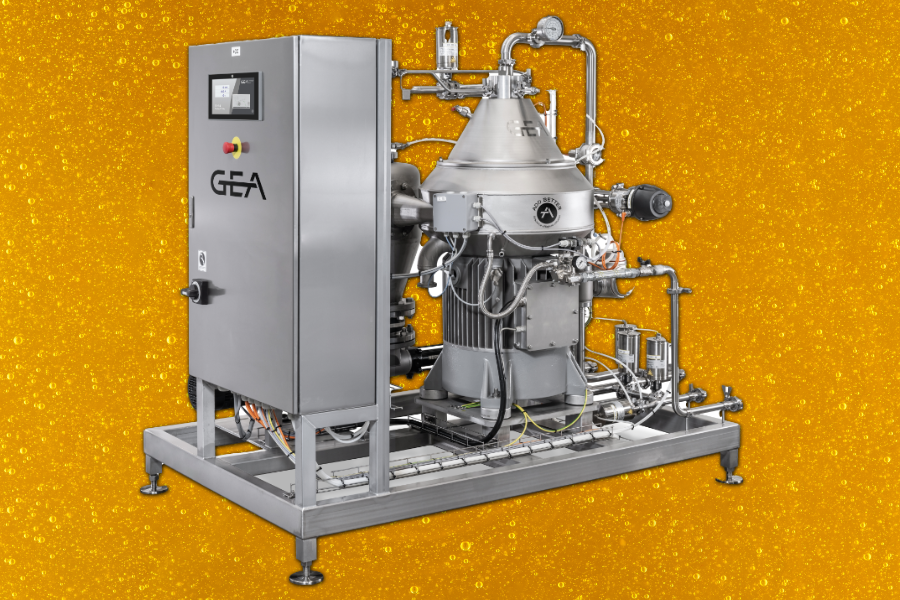
A smart centrifuge designed by GEA
Mechanical engineering company GEA is a long-standing Eplan customer. It explicitly looks for all-in-one solutions that incorporate various engineering disciplines. GEA sells machinery and equipment worldwide – to customers from the food, beverage and pharmaceutical industries, amongst others. Its products include devices known as separators – vertically arranged centrifuges that are used to separate and clarify liquids. One example is GEA’s plug & win i separator, which has been developed for craft breweries and cider producers with the aim of increasing the yield from each batch.
This device was designed in line with the principle of digital continuity. In other words, data from the enclosure design stage was used for further steps and made available to teams from different disciplines, utilising Eplan as the overarching software and platform. Rockwell solutions were also incorporated, as they control the separator. A sector-specific enclosure system from Rittal was used to protect these components. The end result was a continuous flow of data – from the engineering and production stages all the way through to operation and maintenance.
A “holistic” approach of this kind makes it easier to select appropriate hardware. For example, Rittal provides informative data from its various enclosure solutions via the Eplan Data Portal. Integrating the Rittal RiPanel product configurator into this portal ensures from the outset of the planning process that the enclosure selected is suitable for the environmental conditions and can accommodate the envisaged components. As a result of the close link between software and hardware, quality requirements are reliably met. When a selection is being made via the Eplan Data Portal and Rittal RiPanel, engineering-relevant data for the Rittal enclosures is made directly available, thus ensuring the solution arrived at is the right fit.
This same principle applies to other partners and further components. “The digital twin of the machine enclosure, together with its detailed component data, is one of the most important aspects of the project,” explains Simon Budde, Head of Partner Management at Eplan. “This also includes data relating to the components provided by our partner Rockwell Automation,” he adds.
Benefits of a common software environment
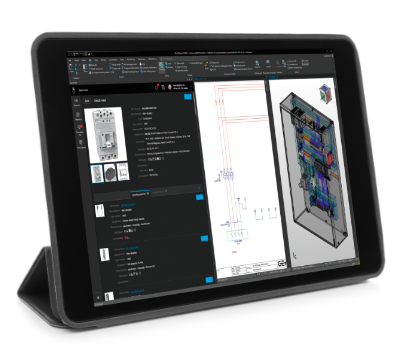
That’s the key advantage of an Eplan project. The solution makes it possible for the various disciplines and different companies involved to use the same software environment, with all relevant data available in one place. This is helpful during the design phase, when manufacturing the enclosure or machine, and later on during operation. That’s because up-to-date documentation is easy to find and changes are mapped digitally straight away. Customers using Rittal enclosures can activate the ePocket digital wiring plan pocket, where data generated using Eplan software at the engineering stage – such as machine documentation for the plug & win i separator – can be filed digitally. ePocket is always up to date and directly accessible from any location. That opens up further possibilities such as the digital documentation of changes in projects using Project Viewer (formerly Eplan eView), including redlining and greenlining. As a result, tracking down where something has been changed, and why, is easy. In other words, all the enclosure information is available in ePocket and doesn’t get lost.
This concept of having one fully comprehensive overview is a huge help, including in the event of glitches somewhere in the machinery, for instance. When a motor stops working, a frantic search for the necessary information – such as the location of the components responsible for controlling and supplying power to the motor – often ensues. The Eplan project maps the interaction of machine functions, so this information is easy to find. Data from the piping and instrumentation diagram, for example, is visualised in the technical preplanning tool Eplan Preplanning, where it is easy to locate the motor and navigate to the relevant point in the wiring schematic.
In our example, a cable connects the centrifuge motor to a PowerFlex 753 drive from Rockwell Automation, a control system for applications up to 400 HP and 270 kW. This is one of over 30,000 Rockwell Automation components in the Eplan Data Portal that can be incorporated into the automation documentation in Eplan using a simple drag & drop operation. The information stored in the portal makes it quick and easy to organise a replacement for the defective component in the drivetrain.
Data exchange using AML
The Eplan project’s data continuity delivers further benefits, because data can be exchanged on an automated basis across different disciplines. For example, it can be transferred to Rockwell Automation’s Studio 5000 programming environment via an AutomationML (AML) interface. This means the data required to program PLCs no longer needs to be input separately. Instead, the interface enables programmers to use the existing data from the Eplan project.