Text Ralf Steck ––– Photography
Pezag was given an unusual challenge by Swiss company TMP AG in Salmsach. It was asked to find a way of fitting a new plant system and associated enclosures into a confined space. As part of a facility for manufacturing fodder blends, an infeed system needed to be installed between the loading ramp and two autoclaves. However, space was so tight in the existing building that it wasn’t possible to find anywhere to install the necessary enclosure alongside the new system.
Nowhere for the enclosure
The planners from TMP and Pezag had to locate the enclosure outside, on the wall of the building, and run the connection cable into the building. Unfortunately, that meant the enclosure – together with its sensitive electronics – was exposed to the elements, including heat in the summer, cold and snow in the winter and rain, too. What’s more, when temperatures are low, it doesn’t take long at all for condensation to form on warm, active components. The planners first considered putting the enclosure in its own little housing, but that would have been expensive and required separate planning permission, which would have delayed the entire project.
Electronics in outdoor garb
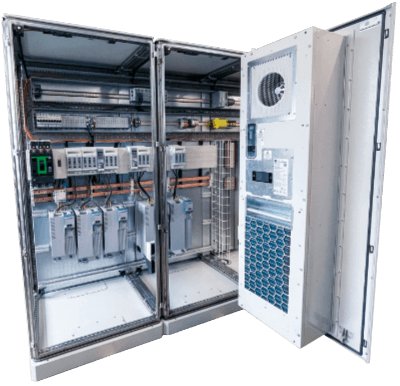
Pezag was able to offer a better solution. Rittal had recently added a bayable model to its Toptec range of outdoor enclosures. This model enables several adjacent modules to be connected together to create a single unit. Since it is already designed for outdoor use, there is no need for an additional housing.
Toptec enclosures are made from powder-coated stainless steel and equipped with a rain canopy for outdoor applications. Besides a double-walled design, they also have water-resistant openings at the top and bottom. This creates a “chimney effect” that results in passive heat dissipation.
In addition, a climate control unit can be fitted in one of the enclosure doors. This controls the temperature inside the enclosure so the electronics can always operate under ideal environmental conditions. External influences and the heat generated by the components installed in the enclosure are both taken into consideration.
Climate control software
To configure the climate control system correctly, the Pezag specialists used the new version of RiTherm for the first time. By taking into account what heat sources are installed where, this software ensures all equipment benefits from the same amount of cooling air.
Importing the design documentation that had been created using Eplan into RiTherm meant no additional work was required to ascertain the position of all the components installed. As Stefan Brühlmann, a design engineer at Pezag, explains: “Three 30 kW frequency inverters are installed, as well as two further inverters with outputs of 18 and 11 kW. The enclosure also accommodates peripheral devices, the power supply and the control system. All that generates a good deal of heat.”
Thermal data for Rittal enclosures is already stored in the software. Having used this to determine heat and loss zones, RiTherm proposes the climate control unit with the smallest dimensions possible that will offer maximum energy efficiency.
Everything ready on time
“Thanks to the new bayed enclosures, we were able to meet the tight schedule,” recalls Brühlmann. “We received the customer’s enquiry on 19 September, and the aim was to have the system ready for delivery before Christmas. Toptec enclosures and the cooling unit are standard products that can be supplied from stock, so we were able to deliver everything on time,” he adds.
“We supplied an all-in-one solution comprising an enclosure, a climate control unit, and calculation and consulting services,” explains Kai Wittlinger from Rittal Switzerland. “That helped Pezag provide a complete solution, meaning everyone was ultimately happy. Most importantly of all, Pezag’s customer could commission its new system on time,” he sums up.