Text Ulrich Sendler, Hans Robert Koch, Steffen Maltzan ––– Photography
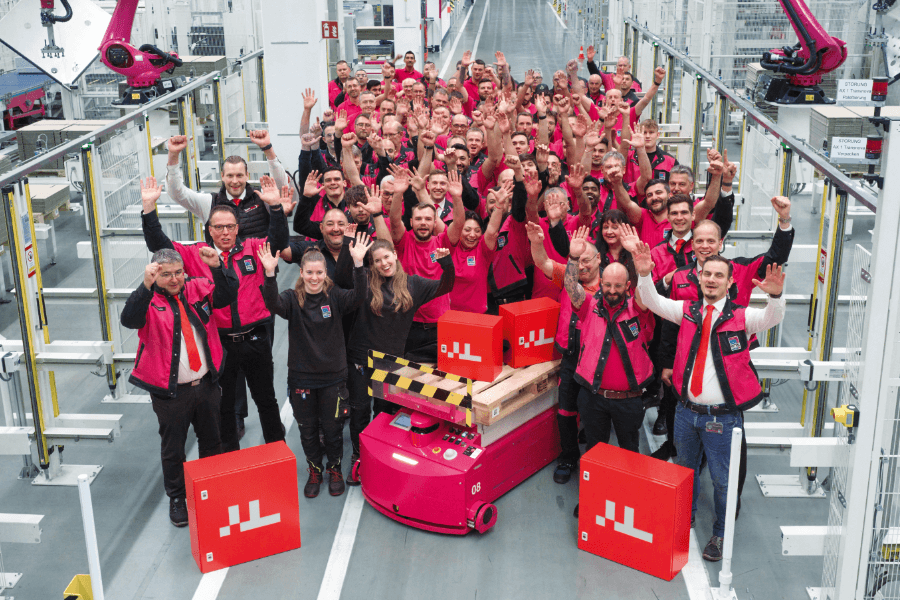
Saying customers come first seems to be stating the obvious, but putting this into practice is no trivial matter. In an industrial context, it means ensuring continuous customer-to-customer process chains, highly transparent and super quick ordering and production processes, and maximum product quality and availability. How can all this be achieved? The Rittal factory in Haiger shows what is possible when digitalisation is thought out and implemented consistently. Production operations here are second to none, and being named “Factory of the Year 2025” means Haiger is now also officially an industry role model for best practice.
When putting together the application for this coveted industry award, which is presented by management consulting firm Kearney and German trade magazine “Produktion”, absolutely everything had to be covered. It set out how Rittal is able to map the entire customer-to-customer process at its factory, from entering a customer order in the system to delivering each individual, fully assembled enclosure. And there are quite a number of them, with up to 9,000 compact enclosures being manufactured in Haiger every day – incredibly quickly and highly efficiently.
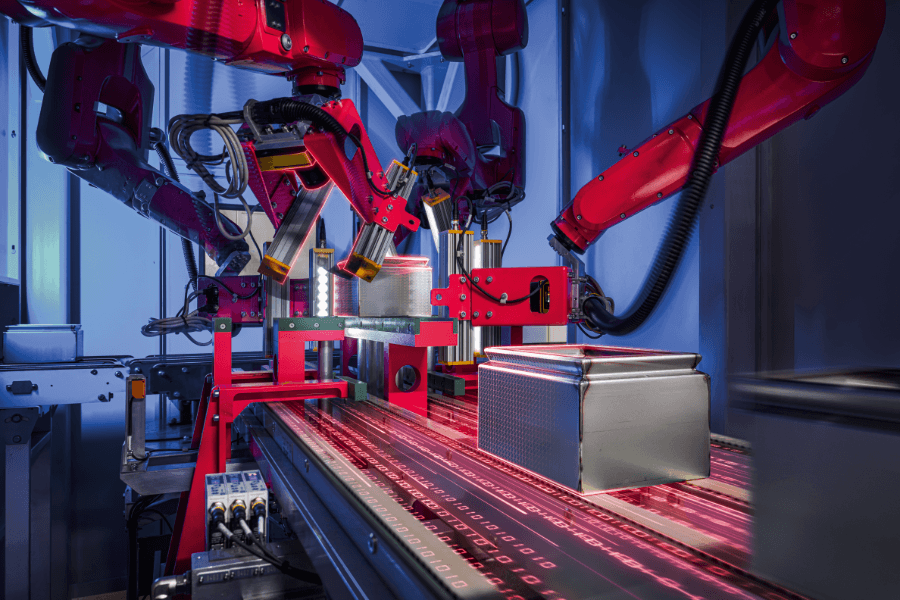
Dennis Benfer, Head of Production Planning and Digital Processes in Haiger, describes it as follows: “From the moment a customer has configured the product they need, the order works its way through the factory and to the customer as if it had a life of its own. Processes interlink with each other seamlessly, passing on all the necessary data on a fully automated basis.” In the words of the judging panel: “The factory has an impressive and exceptionally high level of digitalisation and automation.”
Ordering at the touch of a button
Achieving this meant having to work hard on the process as a whole. Jürgen Kromer, Plant Director in Haiger, knows that these innovations aren’t just helpful in production, though. “Digitalisation also makes order processing entirely transparent and simple for our customers, who come from sectors such as mechanical and plant engineering,” he says.
How exactly does order processing work? Enclosures are designed either in the customer’s system as a digital 3D twin – primarily based on engineering from Eplan – or online, making direct use of mechanical 3D configuration with RiPanel from Rittal, which also contains all the data needed for production. Planners in the mechanical and plant engineering sectors use this approach to design or configure the specific enclosure they need, whether this is a series product or a variant. If everything is included in the data, complete automation is possible. From parts lists and drawings to NC programs for cut-outs and drilled holes – all documentation is generated from pre-existing data at the touch of a button.
Digital production from start to finish
Production scheduling at the Rittal factory takes place overnight and is also automated. What’s more, driverless transport systems ensure all the materials – such as sheet steel – required by each of the machines are provided fully automatically at exactly the right time. Series variants and modifications with additional cut-outs or drilled holes are now no longer built by external partners. Being produced with the same level of automation as series products results in significant benefits and means they can be made much more cost-effective.
How does that work on a technical level? The key is an ingenious combination of standard software and specific enhancements and adaptations. The software for highly digital and automated production of this kind cannot be an off-the-shelf solution. Ultimately, it’s not a specific software solution that makes all the difference, but rather the precise and careful way all the processes are linked digitally. It is Rittal know-how that has made this digitalisation of the entire process possible – understanding each individual step, the steps before and after, and what each step needs for everything to run smoothly. “We ourselves created many of the systems that are being used. We didn’t wait for someone to provide the technologies we need for a digitalised factory,” explains Kromer. This expertise is now an integral part of the digital process that is used as standard for each product. In Haiger, all subprocesses – from configuration and ordering through to delivery – are digitally interlinked to create an end-to-end digital twin of the entire process. According to Benfer, this is the very thing that makes all the difference. “Many companies have already digitalised individual subprocesses, but the digital continuity of processes in Haiger is unique,” he emphasises.
Highly productive AI
As for artificial intelligence, it is already being put to productive use in numerous applications in Haiger and is helping with quality control, maintenance, knowledge management and software analysis. However, AI does not provide the solution. It’s the other way round, in fact. It is because Rittal has done its homework in terms of process continuity that AI can now be used for optimisation purposes. That, too, impressed the judging panel. One example referred to was that, by using AI, Rittal has achieved a 91 percent first-pass yield – a remarkable improvement and one that means time-consuming reworking is now largely a thing of the past.
“Having high-quality data available throughout the entire value chain means we can make targeted use of AI,” says Moritz Heide, Vice President Rittal Digital Operations. “Right from the engineering stage, we use software solutions from our sister company Eplan to help our customers become much faster – and AI will soon have a part to play in this, too. At the factory, our use of AI tools is minimising errors and the number of complaints. Our customers can expect maximum data quality and availability throughout the entire process as standard,” he adds.
99.9 percent planning accuracy
The end result is a statistic that sums up the value of the digital factory in Haiger for customers – the award’s inspectors rated planning accuracy at 99.9 percent. They described witnessing production that was “planned down to the day and supported by AI” so it can deliver such an exceptional result. What’s more, 9,000 enclosures leave the factory every day, and a four-fold reduction in the throughput time has been achieved.
Customers in Europe get their series enclosure a maximum of 24 hours after placing their order, while for customers worldwide, the maximum turnaround is 48 hours. This was the case even during the pandemic. That’s thanks to a combination of customer focus and process continuity across all suppliers. This reliability and transparency in order processing plays a key role for the competitiveness of customers in Europe, especially in times of huge upheavals. “Mechanical and plant engineering companies are currently facing a great many uncertainties, but one thing they can rely on is the fast and punctual delivery of their enclosures,” says Uwe Scharf, Managing Director Rittal Germany and Sales Europe.
Excellent traceability
A further success factor in securing the award was the consistent use of QR codes. If necessary, customers can use these codes to precisely match each element of their product to their project. QR codes also increase the level of transparency and digitalisation at the factory. This is another aspect of the “end-to-end customer focus” that was highlighted in the judging panel’s verdict. According to “Produktion” and Kearney: “The strong focus on getting things done, combined with a continuous improvement process, makes the factory a trailblazer for the factory of the future.” Haiger is a totally transparent pioneer. You can see from each processing step and its end-to-end interlinking how Haiger became a factory of the future – with innovative spirit, engineering expertise and systematic use of software – all at a true German family company.