Text Hans Robert Koch, Daniel Giebel ––– Photography
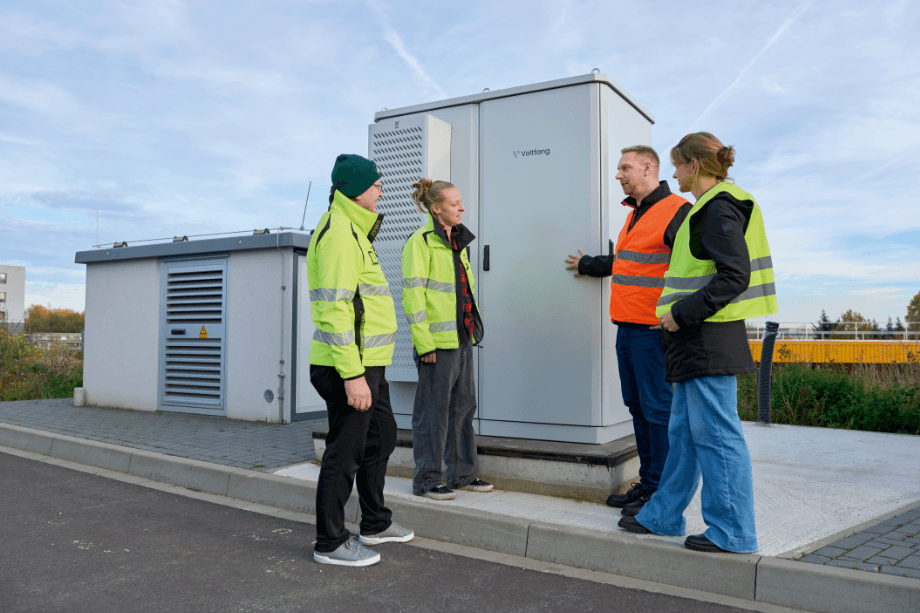
When it came to installing the first battery storage system at the AWA depot on the eastern outskirts of Aachen, it all took longer than planned. However, it wasn’t the technology at fault – it was the groundworks. “The enclosure was so sturdy and so precisely manufactured that we first had to rework the plot to ensure we could install the enclosure completely on the level,” recalls Dominique Grümmer, a technician at AWA Entsorgung GmbH. Not that she considered this a problem. On the contrary – she was impressed. “Given the amount of power it holds, we can’t have things jiggling around.”
Now installed, the system is rocksteady and performs reliably. It smooths out load peaks and stores the energy generated by AWA’s own PV elements on the roofs round about. In the future, it will also support the overnight charging of the fleet of electric vehicles. This innovative energy storage solution has been designed by Voltfang – and its outdoor enclosure comes from Rittal.
SOLUTIONS, NOT COMPONENTS
Voltfang takes second-life battery modules from the e-mobility sector and, after thoroughly inspecting and reconditioning them, reuses them. The technology is just part of what Voltfang offers, however. “We don’t simply supply storage systems. Instead, we offer solutions that address our customers’ specific energy problems,” explains Sebastian Spoo, who is Head of Supply Chain Management at Voltfang. “Whether it’s load peaks, PV integration or network optimisation, we don’t just build battery boxes – we offer complete system solutions.”
The enclosure is a crucial element of these solutions. Felix Nolte, Head of Product Development at Voltfang, sums it up neatly: “You can’t build a scalable product without the right infrastructure. The Rittal outdoor enclosures are perfect for our needs and mean we can offer our storage solutions in the form of standardised, modular systems.”
FROM A FESTIVAL TO THE ENERGY TRANSITION
Nowadays, Voltfang helps with the energy transition by supplying systemrelevant solutions, but it all started with a simple matter of thirst. The eureka moment occurred at a festival, when the battery failed in the camper van shared by friends Afshin Doostdar, David Oudsandji and Roman Alberti – the three future founders of Voltfang. “The three of them managed to get the fridge going again with the help of a solar panel on the roof and an old Tesla battery,” Spoo explains. “That gave them the idea of developing storage solutions based on used batteries.” The three friends officially founded the start-up in 2020 and called it “Voltfang”, which means “volt catcher” in German. The original improvised storage system – which, incidentally, still works – now hangs in the cellar belonging to the parents of one of the three founders as a memorial to the start of it all.
FROM MODULE TO SYSTEM
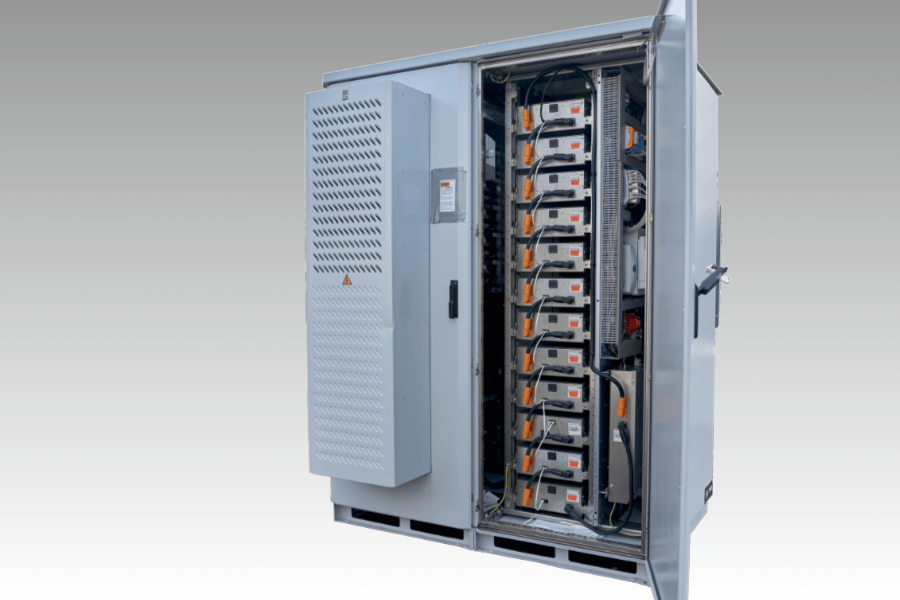
At Voltfang, the battery modules – used, outmoded or superfluous units supplied by partners in the automotive industry – are tested for suitability in a multi-stage process. Only then are the modules equipped with Voltfang’s own battery management software and series connected to form strings. The finished units are installed in enclosures that have been preconfigured in line with the customer’s wishes – complete with cabling, inverters and climate control.
In this respect, the developers enjoy a simple but crucial benefit – availability. “When we need a Rittal enclosure, it’s delivered by the next day at the latest,” Spoo explains. The accessories are modular, too, which saves time and cuts down on coordination work.
OUTDOOR USE ALWAYS FACTORED IN
The partnership with Rittal can be traced back to the early days of the start-up. Carsten Wessel, who is an energy expert at Rittal, has been providing support from the outset. “The great thing was that Voltfang already had a working indoor solution. Together, we used this to develop an outdoor version relatively quickly. It took just three months to make the platform suitable for outdoor use.”
The end result is standardised storage solutions that can be scaled on a modular basis. The TopTec enclosures with climate control can be adapted to suit different requirements – from a single system for agricultural use to multi-string solutions for industry or energy ports. “The Rittal enclosures offer us all the flexibility we need to deal with everything from high ambient temperatures to enhanced safety requirements,” Nolte explains.
STORING ENERGY WHERE IT IS PRODUCED
Voltfang has long since been handling large-scale projects all over Germany and further afield, too. These include storage systems for Jet filling stations to relieve pressure on their rapid charging infrastructure, as well as systems at Stuttgart Airport and for customers in the energy trading sector. Following production in Aachen, the modules are delivered preassembled and installed on the customer’s premises by in-house teams or certified sales partners.
The target group is very diverse. “We have customers in the metalworking industry, farmers with extensive PV areas, as well as companies with fluctuating consumption or that need to expand their network,” says Spoo. As he explains, demand for outdoor solutions is particularly high. “Inside space is always limited and expensive for companies, so 80 to 90 percent of our storage systems are set up outdoors.”
A SMART FIRE-PROTECTION SOLUTION
The trend for outdoor solutions offers an additional benefit, too. “Especially in the case of key accounts, customers, building insurance companies, municipal authorities and fire brigades all have stringent requirements,” Spoo says. In many cases, there was a lack of suitable fire protection compartments, adequate ventilation or secure access for the new work areas to be created. “We initially came up against obstacles relatively frequently, because customers were unable to meet structural requirements in indoor areas without a lot of extra organisational or financial outlay.”
The logical solution was to install storage systems outdoors, the requisite safe distance away from buildings. “This means we can implement projects that wouldn’t be possible indoors due to regulatory requirements.”
ROBUST, EFFICIENT AND READY FOR USE
When it comes to outdoor use, a weatherproof solution isn’t all that matters, though – operational safety is vital, too. “A fully equipped enclosure with a storage capacity of 180 kilowatt hours weighs almost two metric tons, so it’s vital that everything is just right – from structural factors and effective sealing to climate control,” Nolte explains. Voltfang traditionally opts for enclosures from the Rittal TopTec range.
These stainless steel enclosures boast the IP 55 degree of protection and can even be adapted to suit adverse environmental and weather conditions. The energy-efficient cooling systems can be replaced, which makes maintenance and upgrades easier. Rather than merely supplying hardware, Rittal provides a genuine energy transition platform that Voltfang can use to take things to the next level.
CONCEPT WITH A PROMISING FUTURE
Back at the AWA site in North Rhine-Westphalia, a second storage system is already being planned. Energy Manager Oliver Bode is delighted. “This makes us almost energy self-sufficient – and that wouldn’t be possible without the storage system.” Rümmer is equally positive. “It’s obvious that the system is really well thought out. It’s no longer a prototype – it’s a genuine product for daily use.”
What started out some years ago as a fun challenge at a festival has long since become a highly promising solution. And, with the correct hardware in place, the system is delivering a precise performance.