Practice · Supply chains in the plastics industry
A MEATY
PROBLEM
No spools mean no sausages — in the longer term, at least.
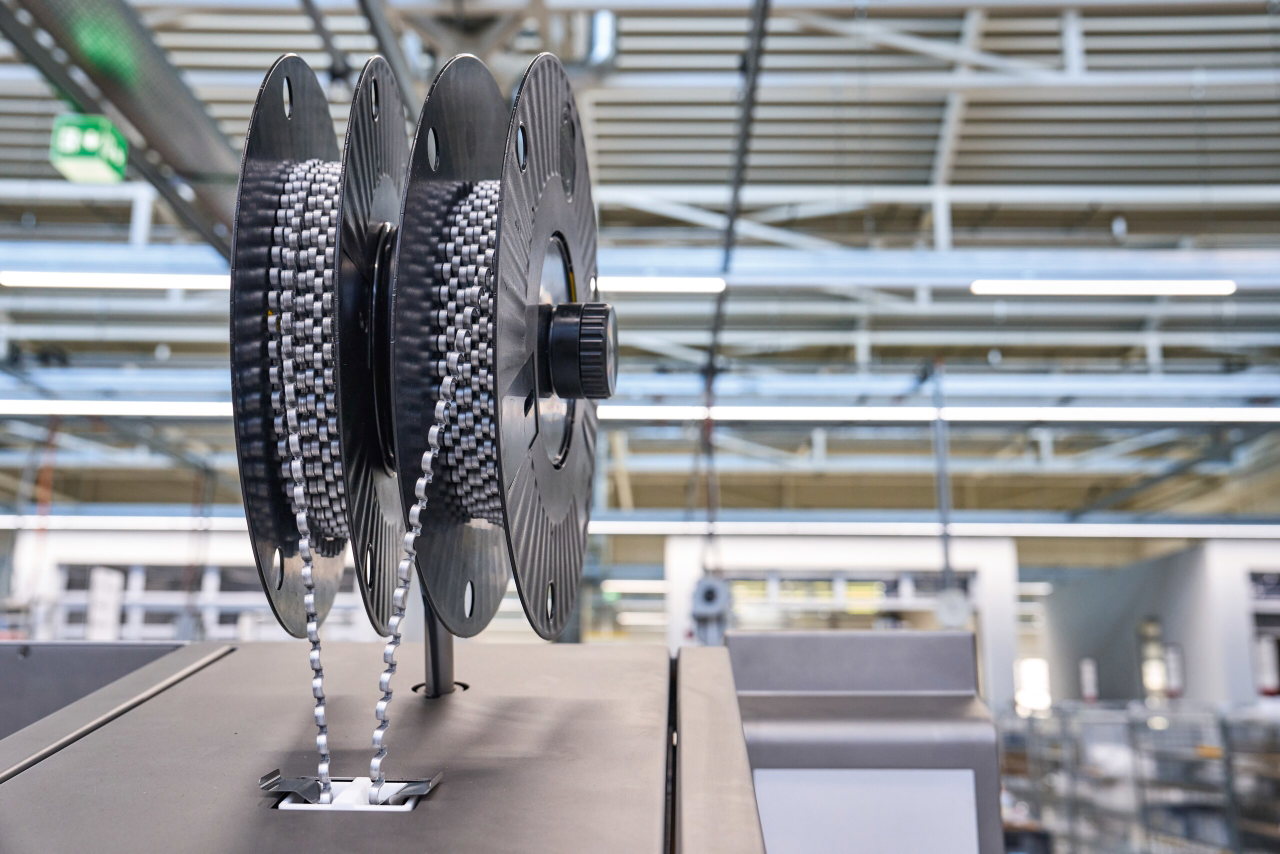
The plastic spools are mounted on the clip machine manufactured by Poly-clip, and the clips are fed into the machine from there.
LKH produces plastic spools for metal clips that are absolutely crucial in sausage filling machines. Without these spools, production will grind to a halt, so LKH safeguards its supply chain by prioritizing intelligent material strategies and close relationships with its suppliers — and by drawing on the strength of the Friedhelm Loh Group.
Text: Ulrike Peter
Just a few years ago, companies looking to purchase plastic granulate had one key question in mind — where can we get hold of the material at the best price? Now, what they want to know is whether the material will still be available tomorrow. The pandemic, geopolitical crises, and volatile raw materials markets have completely changed the rules of play. Security of supply is now the top priority — and that starts with the choice of materials and an in-depth understanding of the entire supply chain.
150 raw materials are too many
In the past, LKH Kunststoffwerk Heiligenroth tended to go with whichever material the customer specified. This meant LKH sometimes had around 150 different raw materials in use. But that all changed when supply chains were severely disrupted. Now, the material experts work with customers during the tender phase to establish whether there is a material that has already been approved and meets the same technical requirements. Besides reducing the number of material variants, this approach increases the security of supply and means purchase volumes can be consolidated. What’s more, sustainability aspects such as the option of recycled granulate can be factored in at this early stage when deciding which material to use.
“Expertise in materials is about more than just selecting the correct plastic. We also consider long-term availability, cost-efficiency, and sustainability.”
Steffen Diehlmann
Head of Sales and Supply Chain Management at LKH
Second-source strategy
To increase security of supply, LKH has adopted a second-source strategy. On the face of it, that sounds straightforward — if there are two suppliers, that ought to mean guaranteed supplies. In practice, though, it often doesn’t work that way. If, for example, both these suppliers buy their glass fibers or flame retardants from the same manufacturer, there’s not actually any change in the level of dependency. That’s why, nowadays, it’s important to look beyond the direct supplier. LKH can draw on the strength of the Friedhelm Loh Group in this context. In tandem with the Rittal procurement team, upstream goods flows are analyzed and potential bottlenecks and critical production locations are identified. If robust procurement strategies are to be put in place, this transparency is a must.
Global procurement of raw materials by Rittal clearly revealed the importance of looking at the value chain in its entirety. At the time when the conflict in the Middle East was escalating, the preliminary materials being used by an aluminum supplier came from Qatar. With virtually no time to spare, a decision had to be made about whether to relocate materials or approve an alternative supplier. “If you know the supply chain inside out, right from its roots, and maintain close relationships with suppliers, you gain valuable time in situations like that,” explains Markus Schmidt, Director Global Commodity Management at Rittal.
“As experience over recent years has shown, everything hinges on supplies.”
Markus Schmidt
Director Global Commodity Management, Rittal
5 million euros invested
A crisis reveals how agile a company is. When raw material markets became volatile, LKH decided within a week to increase its safety stock levels. The team examined each item in turn to establish which materials it would be worth stocking up on. In the case of some materials, LKH built up stock levels that would last for up to six months. This involved renting additional warehousing space and investing over five million euros in raw materials.
The fact that LKH is part of the Friedhelm Loh Group was also key to making this possible. As a center of excellence for plastics, LKH approves materials, consolidates purchasing volumes, and organizes the pooling of plastic granulate within the Group. External customers also reap the benefits of bigger purchasing volumes, well-established relationships with suppliers, and stable supplies. Customers are generally unaware of all this — and that’s exactly what resilient supply chains should mean.

Friedhelm Loh Stiftung & Co. KG · Rudolf-Loh-Straße 1 · 35708 Haiger · Germany · betop@friedhelm-loh-group.com

© Friedhelm Loh Group 2026 · be top – Magazine of the Friedhelm Loh Group