Innovations · Hyperscalers
In the engine room of the
AI revolution
International hyperscalers are investing massive sums.
AI is driving a globally growing market for IT infrastructure with new architecture. The key technologies aren’t just coming from the USA or Asia, though — European companies such as Rittal are also helping to drive progress.
Text: Steffen Maltzan
Millions of people use AI tools such as ChatGPT, Claude, and Copilot, and yet industrial AI is only just getting started. Companies are now working flat out to build the necessary physical infrastructure — AI data centers.
Hyperscalers are locked in a race involving massive investments. Some 725 billion US dollars has been invested this year, which is roughly equivalent to the GDP of Belgium. It’s not just a question of who will provide the best-performing infrastructure at the right time, though. The concepts for technological implementation are also in competition. The best possible balance between computing power and energy consumption needs to be found.
Hyperscalers
In a nutshell
billion $
That is the sum hyperscalers alone are set to invest in IT infrastructure in 2026.
million
euros is being invested by Rittal to expand its IT infrastructure production in the USA and Europe.
right to the limits
It won’t just be software and chips that determine the next level of artificial intelligence in data centers. It’s all about the physics, with the focus on steel, copper, water, and electricity. Thousands of processors called GPUs need to work together in the most confined of spaces. If they’re just a few meters too far apart, even minimal attenuation of copper cables will slow things down noticeably. “The GPUs are a data center’s most valuable asset and need to be used to their full extent. Even the tiniest delays quickly add up. That’s why each new generation of chips is generating a higher output in an increasingly small space,” explains Philipp Guth, CTO of Rittal. This progress is pushing things to the limits of what is physically possible.
Take heat, for example. Air is an appropriate cooling medium for up to around 30 kilowatts per server rack. At over 100 kilowatts per rack, however, even today’s AI systems are operating well beyond this level, and there is already talk of outputs exceeding one megawatt. That requires direct water cooling for the chips.
It’s all change for the electricity supply, too. AC solutions are well-established, but losses are a bigger consideration when power densities are extremely high. Interest in DC solutions is therefore growing — initially in the rack and later on all the way to the grid connection.
What does that mean for the infrastructure? Standardized racks are still the backbone of data centers. Rittal is one of the big manufacturers, having supplied 180,000 racks to hyperscalers worldwide in 2025 alone. Demand is growing so fast that the family business is investing just under 100 million euros in expanding production in the USA and Europe.
Standardization needs to be taken a step further for AI data centers, though. “When it comes to computing power, electricity, and cooling, a high level of mechanical integration is required in the most confined of spaces. The degree of standardization also needs to be such that the modules can be used in large numbers both quickly and cost-effectively,” says Guth.
“The system-based approach for cooling, rack, and power reduces losses and makes scalability and service easier, so AI-capable infrastructure can be up and running faster.”

Philipp Guth
CTO, Rittal
Equivalent to 20,000 laptops
New possibilities are emerging through the Open Compute Project (OCP), for example. In this project, top international players are working on the infrastructure of the future. Rittal has taken rack standardization to the next level and has now developed a complete OCP-compatible solution that incorporates rack, direct water cooling, and power supply. Barely larger than a side panel, the module can supply an output of one megawatt, which is equivalent to around 20,000 laptops. The 800-volt DC technology is familiar from e-mobility applications, and the result is a basic supply unit for scalable data centers.
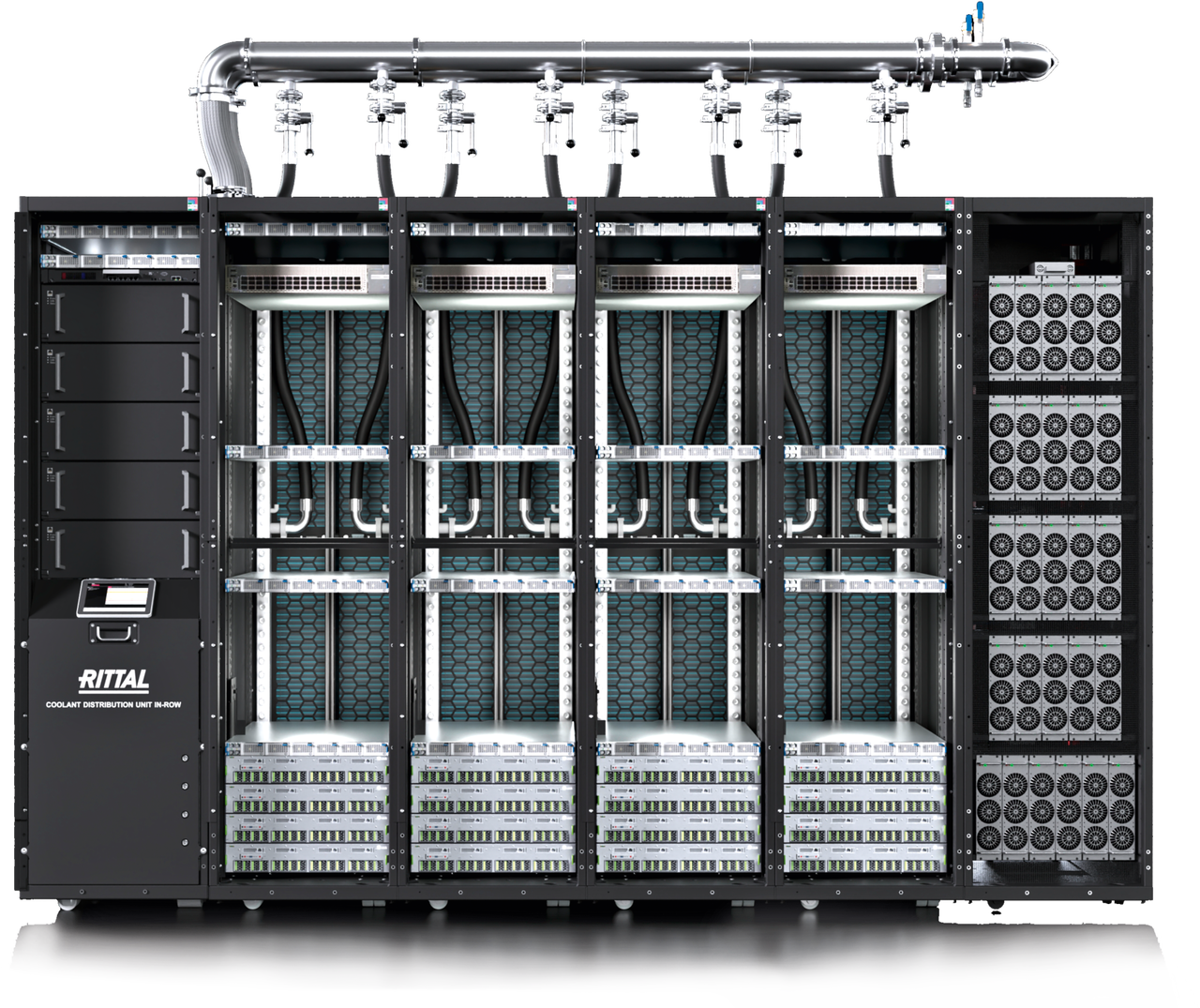
Direct water cooling, server racks, and power supply for an output of over one megawatt in a standardized module for AI infrastructure.
European sovereignty
In Europe, AI infrastructure of this kind is more than just a question of technology. Data sovereignty, energy efficiency, and the smallest possible carbon footprint, complete with heat recovery, are becoming key factors for the siting of data centers. There are good reasons for using local vertical integration to become more independent. Although it’s currently US software platforms that often dictate AI-related discussions, much of the necessary physical infrastructure is being produced using technology from Europe. In this context, Germany’s Federal Minister of Research Dorothee Bär presented the ZVEI’s Electrifying Ideas Award to Rittal, GSI Helmholtzzentrum, and etalytics in May.
AI factory with Rittal solutions
Their joint project has already reached the practical implementation stage.
Over 8,000 high-output GPUs will soon be up and running at the new IT4LIA AI factory in the supercomputing hub of Bologna. This factory is part of the European initiative for sovereign AI infrastructure. It uses direct liquid chip cooling made in Europe — developed by Rittal and manufactured at the Rittal plant in Italy.
Next article
Engineering and AI
The Eplan Platform 2027 and Eplan Copilot at a glance.

Friedhelm Loh Stiftung & Co. KG · Rudolf-Loh-Straße 1 · 35708 Haiger · Germany · betop@friedhelm-loh-group.com

© Friedhelm Loh Group 2026 · be top – Magazine of the Friedhelm Loh Group