Practice · Netmountains
Taking the heat off
AI
Using water to keep AI up and running, the new Netmountains data center in the German town of Velbert has created a blueprint for next-generation digital infrastructure in the space of just six months.
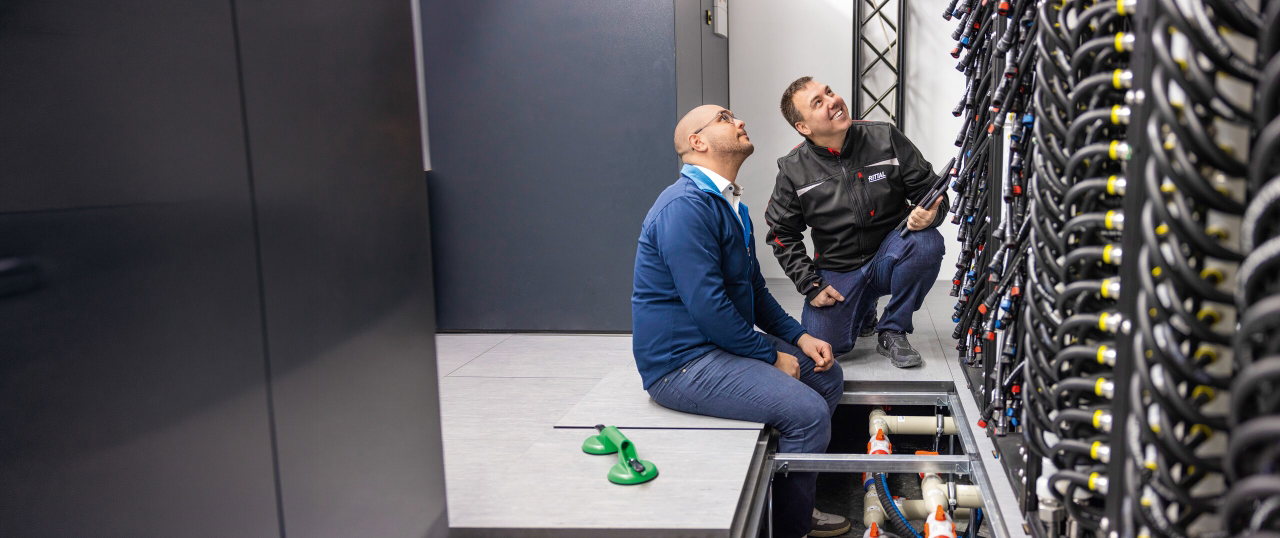
Working together to develop a liquid cooling solution at Netmountains: Felix Kremelic´, IT Projects Lead at Rittal (left) with Ergin Sarac, Data Center Specialist at Georg Fischer.
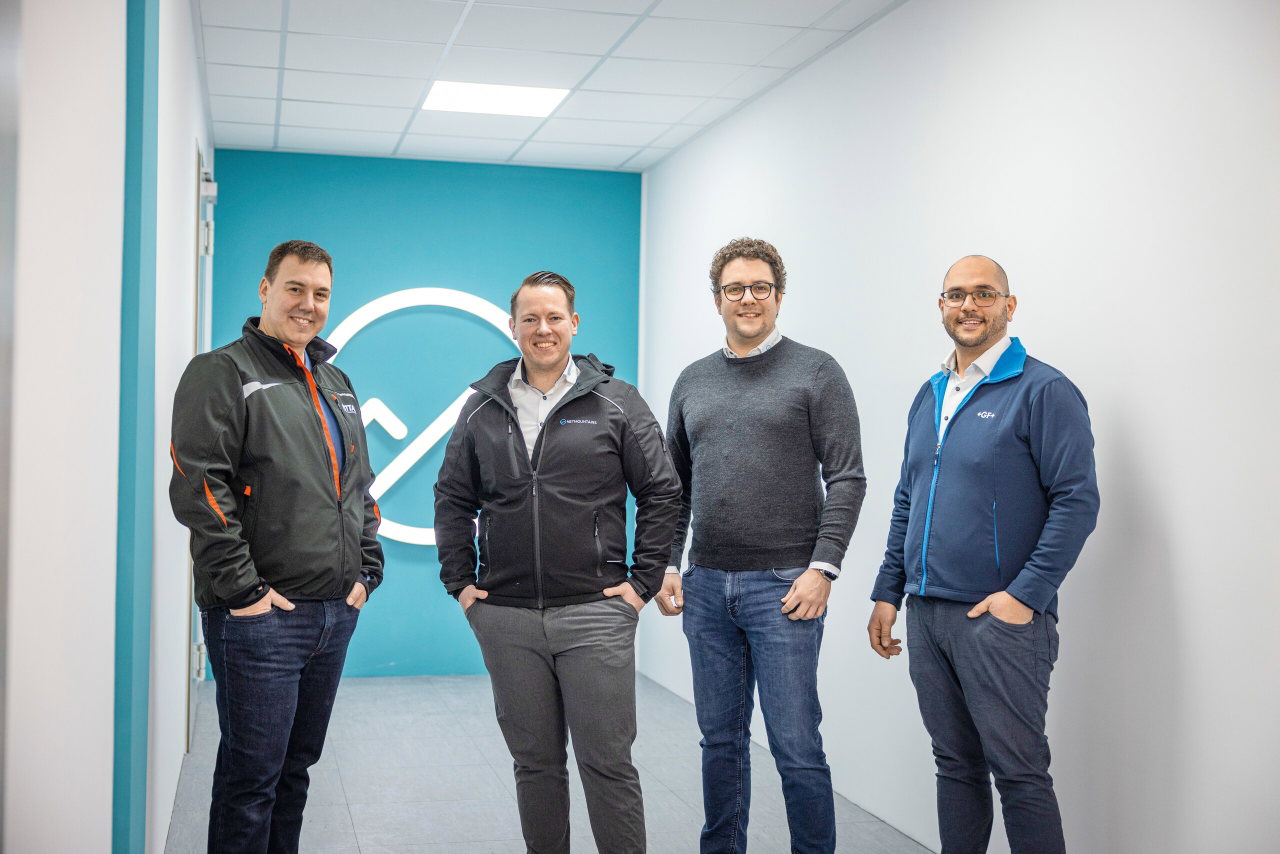
Working with Rittal and Georg Fischer — a leading supplier of flow solutions based in the Swiss town of Schaffhausen — the colocation provider Netmountains has created a data center for the future, complete with innovative cooling architecture that means high AI power densities are now possible.
Text: Ulrike Peter
When planning a data center these days, companies already need to consider future requirements. Artificial intelligence, high-performance computing (HPC), and other data-intensive applications are driving up power densities to a whole different level, which calls for more and more computing power in ever smaller spaces. All of this also means higher thermal loads. Air cooling was previously able to cope with the amount of heat being generated but is now increasingly reaching its physical limits.
The IT service provider Netmountains also found itself facing this challenge. When building a new colocation data center at its headquarters in Velbert, the company therefore factored the requirements of future AI applications into the design right from the outset.
“Our vision was to build a data center fit for the future.”

Stephan Reugels
Co-founder and CEO, Netmountains
When air reaches its limits
Instead of updating established concepts, the team in charge of the project opted for a fundamental change of perspective that involved viewing cooling as an integral part of the overall IT infrastructure rather than a separate process.
After all, a new mindset is vital. AI infrastructure solutions are now being designed for dozens of kilowatts per rack, with even higher values expected in the future. And the more powerful processors become, the more difficult it is to use air alone to reliably remove the heat generated.
Direct liquid cooling (DLC) is therefore based around the cooling medium of water, which is conveyed via special cooling circuits directly to the processors to absorb the heat exactly where it occurs. The amount of thermal energy water is able to transport is many times higher than the amount air can absorb. This makes much higher power densities possible and also boosts the entire data center’s energy efficiency.
By designing the new data center for cooling outputs of up to 66 kilowatts per rack, Netmountains has created the conditions for demanding AI and HPC applications and got ahead of the curve in a market where requirements are currently changing fast.
In a nutshell
Global colocation capacities
GW
Now: global colocation capacity
GW
Over: global colocation capacity (predicted)
What is colocation? Colocation is when an organization operates its own IT systems in an external data center. Among other things, colocation providers offer the necessary space, a power supply, cooling, a network connection, and physical security. Global colocation capacity is expected to rise significantly in the coming years.
Source: Structure Research, Global Center Market Outlook 2025
Cooling as part of the overall system
The project’s defining features extend beyond liquid cooling, though. The holistic approach is also crucial. Working with Georg Fischer, Rittal developed a fully integrated cooling infrastructure that covers all parts of the cooling circuit — from building cooling through to the server racks.
“Our task was to incorporate all elements of the cooling system in one reliable, integrated solution,” explains Felix Kremelic´, IT Projects Lead at Rittal. “By combining our IT infrastructure and cooling expertise with Georg Fischer’s flow solutions based on polymer rather than metal, we were able to create a scalable high-performance system that meets current requirements and is also fit for future workloads,” he adds.
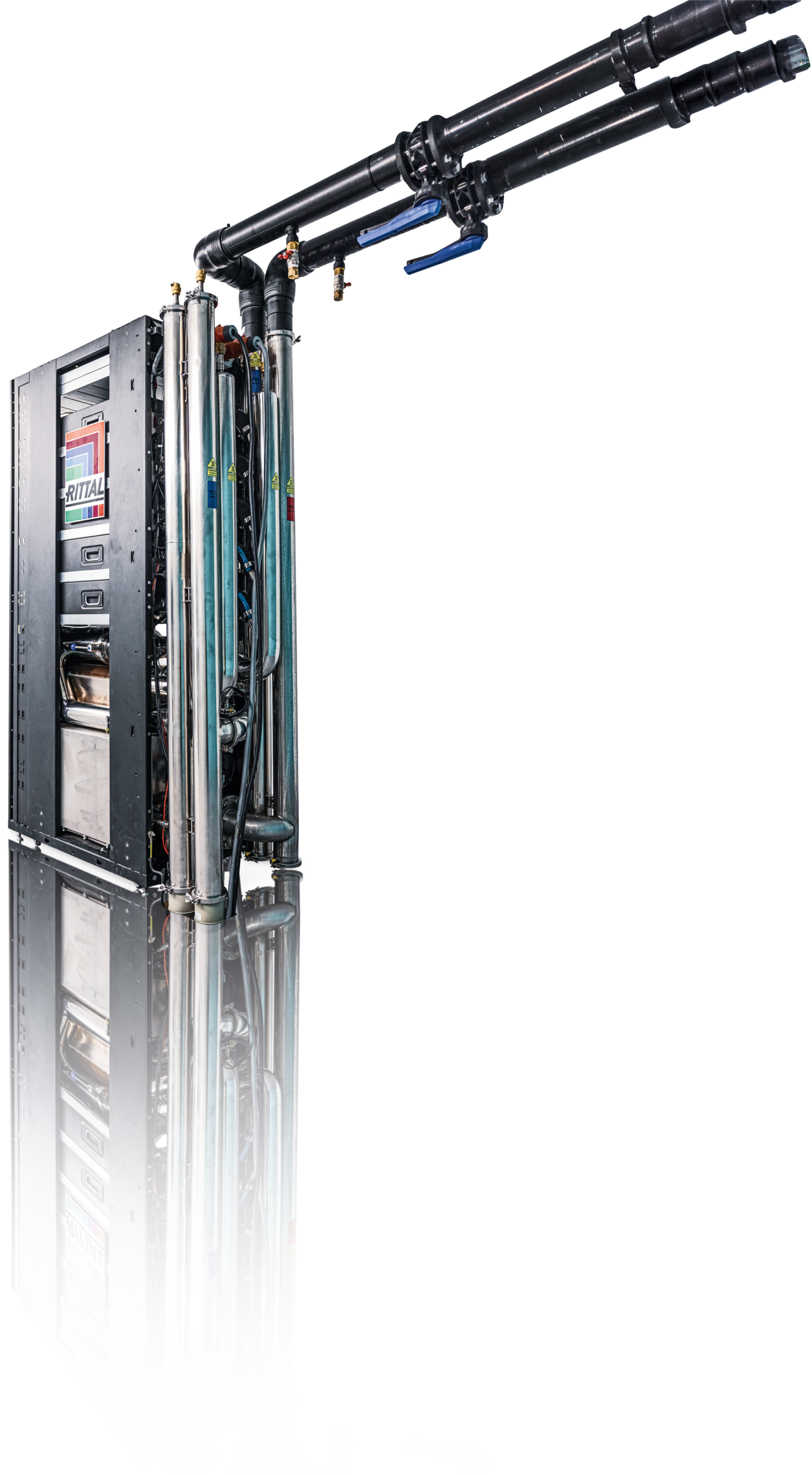
Rittal was responsible for integrating the entire cooling system, and its newly developed cooling distribution unit (CDU) acts as the key interface between building cooling and IT cooling. This compact unit generates a cooling output of over one megawatt to supply numerous high-performance racks with an appropriate level of cooling. Its modular design means it can be incorporated flexibly into a variety of data center environments.
Georg Fischer provided the entire polymer-based infrastructure for the pipework and the technical cooling networks, including the pipe systems for building cooling and distribution within the data center, all the way into the IT racks.
The result is an end-to-end cooling infrastructure that connects all the various levels and can be expanded. New capacities can be added in stages without changing the basic architecture. That’s a key advantage for a colocation provider such as Netmountains, as the infrastructure can grow in line with customers’ requirements.
“Together, we’ve developed an end-to-end cooling circuit — from building cooling all the way into the racks.”

Ergin Sarac
Data Center Specialist, Georg Fischer
Key role for plastics
The growing popularity of liquid cooling also means more attention is being paid to the materials involved. Although metal is traditionally used in many applications, companies are increasingly turning to engineering plastics for cutting-edge cooling concepts.
There are many different reasons for this. Polymer-based pipe systems are corrosion-free solutions and don’t release any particles into the cooling medium. Besides ensuring the cooling circuit remains free of contamination, this also means less rinsing and maintenance work is required. There are practical benefits during installation and operation, too. Plastics are much lighter than comparable metal solutions, offer excellent resistance to chemicals, and exhibit low thermal conductivity, which minimizes the risk of unwanted condensation. What’s more, welded joints permanently rule out any system leaks. “Together, we’ve developed an end-to-end cooling circuit — from building cooling all the way into the racks. That reduces the number of interfaces, simplifies installation, and creates the basis for stable long-term operation,” says Ergin Sarac, Data Center Specialist at Georg Fischer.
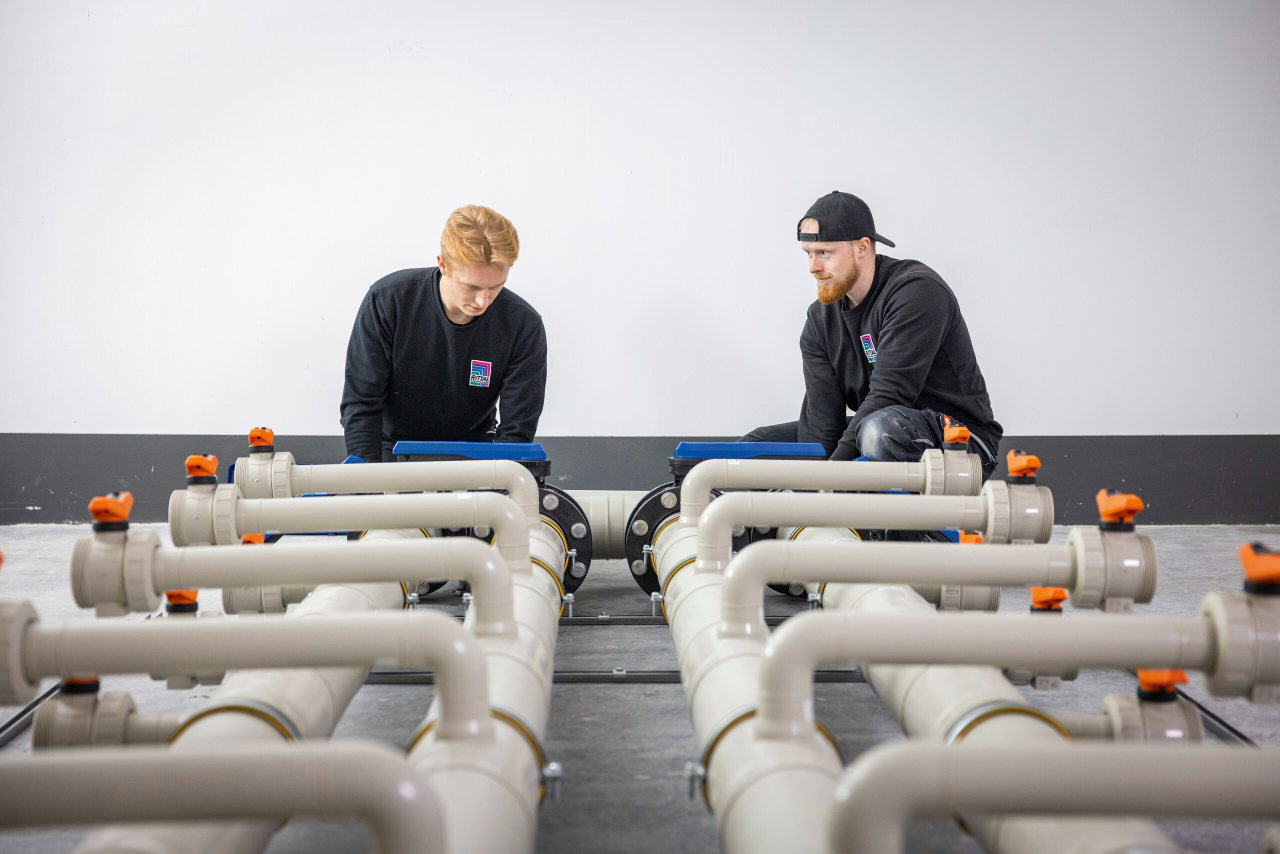
Polymer instead of metal — Georg Fischer has equipped the data center with pipework technology fit for the future.
Blueprint for the next generation
The new data center in Velbert gives Netmountains a basis for future growth and new business models for AI infrastructure. The project also demonstrates how the sector is changing. The previous focus on optimizing individual components is now shifting toward the interaction of all the various systems.
A new benchmark has been set — cooling, energy supply, and IT infrastructure must be viewed and planned as one overall system. “The colocation data centers being built today need to be designed for the use of AI. Together with Georg Fischer and Netmountains, and in the space of just six months, we have demonstrated a cost-effective and scalable approach to creating an infrastructure of this kind with all the necessary elements,” says Uwe Scharf, Managing Director Sales Germany & Europe at Rittal.
Video
Find out more in the video
This content is blocked by your cookie settings. 🍪
You can change this in the cookie settings or accept and load it for this visit only.
Video: Friedhelm Loh Group (movingimage) – only loads once you have given your consent
Next article
TOBOL
What makes the systems integrator TOBOL competitive.

Friedhelm Loh Stiftung & Co. KG · Rudolf-Loh-Straße 1 · 35708 Haiger · Germany · betop@friedhelm-loh-group.com

© Friedhelm Loh Group 2026 · be top – Magazine of the Friedhelm Loh Group